Territory operating system
FR / 04One command center. Four territories.
A shared brand and technical backbone designed to carry locally specific services, proof, and operating reality across Texas, Utah, Idaho, and Colorado.
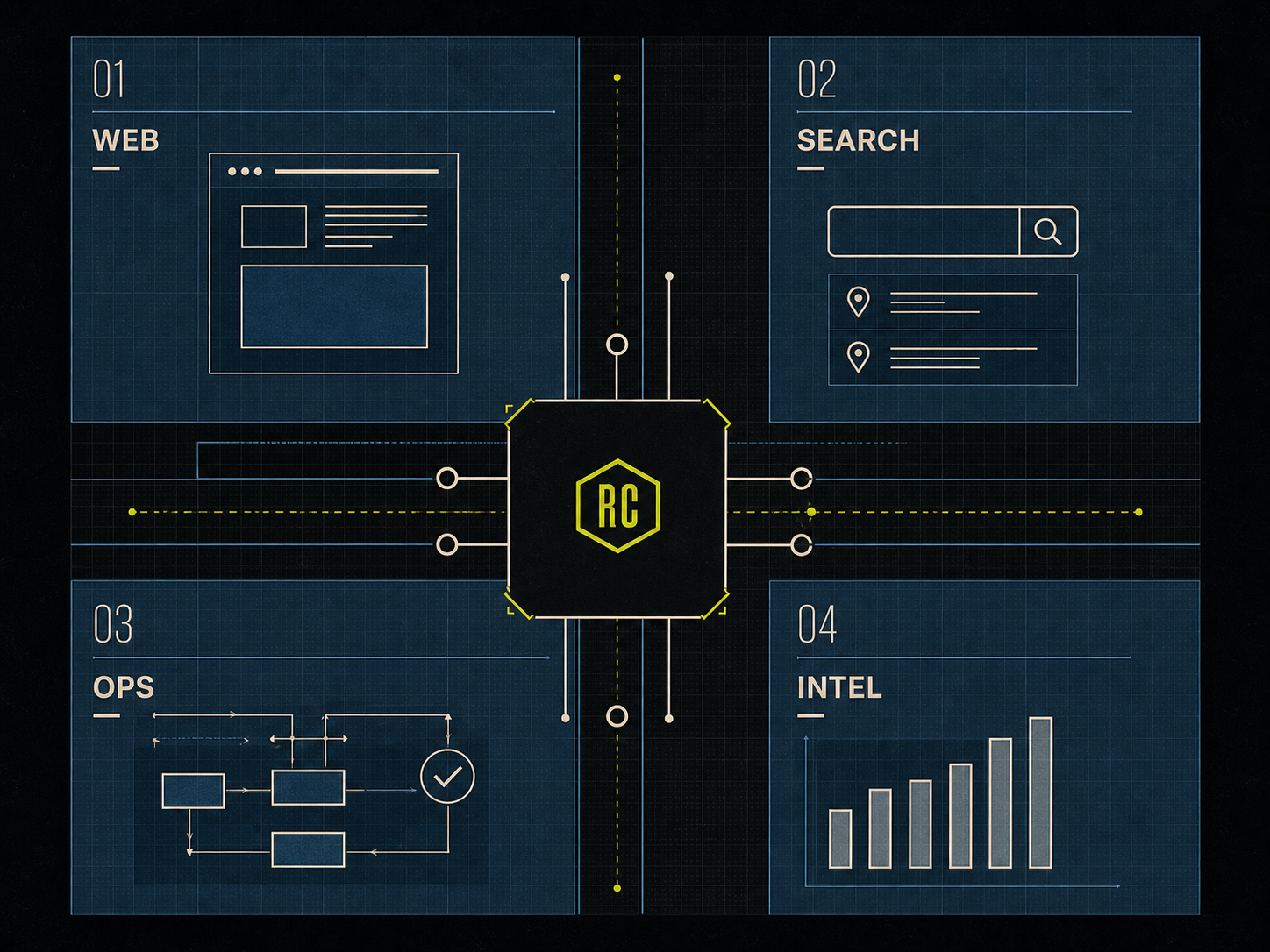
One operating standard
Shared brand and platform
Web, search, evidence, intelligence
Locate, build, advance
The constraint
Expansion without system drift.
Expansion creates drift when every territory launches its own pages, search program, proof, and reporting. The business needed one repeatable operating standard without flattening the local differences that make each market believable.
Operating doctrine / FR / 04Centralize the system. Localize the truth. Feed every market’s learning back into the command layer.
System map
One backbone.
Four working layers.
Shared web platform
One durable information architecture, conversion system, component standard, and release path carries every territory.
Local search layer
Each market earns relevance through its real services, weather patterns, operating area, people, and proof—not swapped city names.
Field evidence loop
Completed work, owner input, service updates, and market changes flow into a repeatable publishing and verification process.
Command intelligence
One reporting language shows what is live, what is blocked, what changed, and which market needs the next useful move.
01Texas
02Utah
03Idaho
04Colorado
Deployment sequence
Locate. Build.
Advance.
Locate the shared standard
Map the offer, service paths, territories, proof sources, and systems that must remain consistent.
Build the territory kit
Create repeatable templates, evidence requirements, local-search patterns, and operating checkpoints.
Deploy market by market
Launch against local ground truth, verify the full customer path, then feed learning into the next territory.
Your next market
Build the system before the expansion.
Use the same briefing process to map the constraint, markets, and operating layers your next stage requires.
Start your project brief